
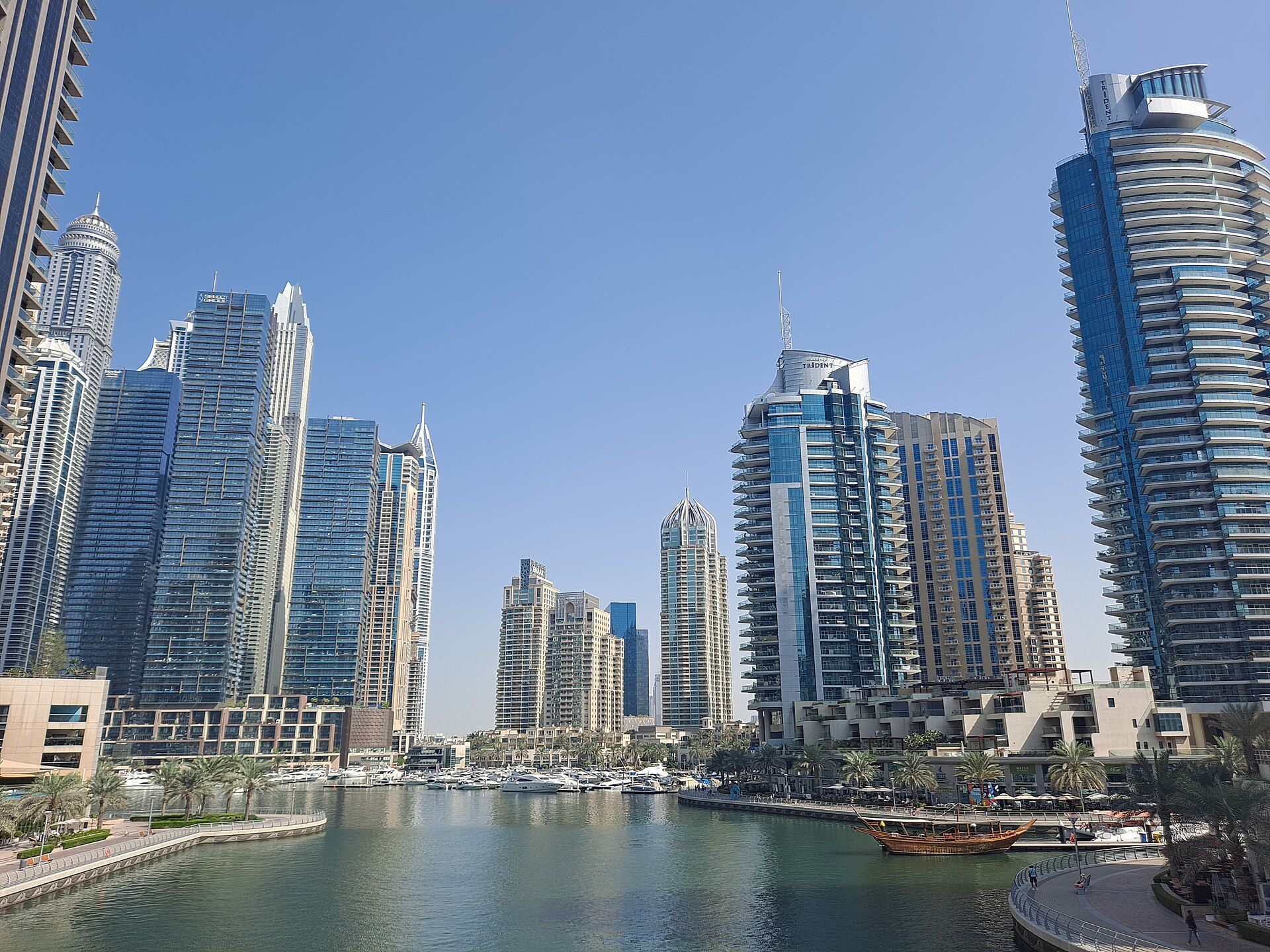
The United Arab Emirates.
Why do people want to live there?
The reasons people choose the UAE that stand out: no income tax on individuals, long-term residency options and areas where foreigners can own property. This page collects the basics from official sources. The source for each point is listed at the bottom.
Why the UAE
Six concrete reasons
No income tax for individuals
The UAE does not levy income tax on individuals. A 5 per cent value added tax (VAT) applies to purchases of goods and services.
A defined corporate tax for companies
Corporate tax applies to financial years starting on or after 1 June 2023: 0 per cent on taxable income up to AED 375,000 and 9 per cent on the portion above it.
A residency route for property investors
Investors who own property worth at least AED 2 million can apply for Golden Residency. The property must be fully owned and registered in the investor’s name.
Sponsorship for family
According to the Dubai Land Department’s investor service, a spouse, children and parents can be sponsored.
Areas open to foreign buyers
Foreigners can own property in Dubai’s freehold areas and in Abu Dhabi’s designated investment areas.
Two emirates, two sets of rules
Dubai and Abu Dhabi are separate emirates. Title registration, fees and the areas where you can buy are regulated separately in each.
Tax
The tax picture
Income tax
The UAE does not levy income tax on individuals. It has agreements with other countries to avoid double taxation on investments abroad; which agreement applies to you depends on your situation.
VAT
The standard rate is 5 per cent. It is levied at each stage of the supply chain and borne by the end consumer.
Corporate tax
0 per cent on taxable income up to AED 375,000 and 9 per cent above it. Qualifying free zone companies have separate rules for qualifying income.
Property transaction fees
In Dubai, registering a sale contract costs 4 per cent of the contract value. In Abu Dhabi, registering the sale of an off-plan unit costs 2 per cent of the contract value (TAMM). Rates can change; we check the current figures before any transaction.
Your own country’s rules
The absence of income tax in the UAE does not by itself remove obligations in another country where you live or are a taxpayer. This depends on the individual; ask your tax adviser.
Residency, visas and citizenship
What owning property does and does not give you
Golden Residency (investor)
You need property worth at least AED 2 million in total (ICP: fully owned and registered in the investor’s name), valid health insurance and a passport valid for at least six months. Duration and conditions are set by the authorities and can change; we check the current position before any application.
Mortgaged property
According to the Dubai Land Department, if the property is mortgaged, a bank letter confirming that AED 2 million has been paid is required.
Retiree residency
According to the Dubai Land Department, retirees aged 55 or over who own property worth at least AED 1 million, paid in full and unmortgaged, can apply for a renewable five-year residence permit.
Citizenship
UAE citizenship can be granted to foreigners in certain categories, including investors, when they are nominated. Owning property in the UAE is one of the conditions for the investor category; citizenship is granted by nomination, not as a right you can apply for.
Buying property
The rules for foreigners in Dubai and Abu Dhabi
Dubai
Foreigners can own property in freehold areas. Registration in the name of companies owned by non-UAE nationals is also possible, subject to the Land Department’s conditions.
Abu Dhabi
Foreigners can own property in designated investment areas. According to the official portal, this covers residential units such as apartments and villas, not land. Areas and scope are updated by the authorities.
Bank finance
The Central Bank of the UAE caps loan-to-value ratios. For an expatriate buyer’s first home, the maximum is 80 per cent for property under AED 5 million and 70 per cent above it. The bank decides whether to lend.
Frequently asked questions
- Is there income tax in the UAE?
- No income tax is levied on individuals. VAT of 5 per cent applies to goods and services. Corporate tax applies to financial years starting on or after 1 June 2023: 0 per cent up to AED 375,000 and 9 per cent above.
- If I pay no tax in the UAE, do I avoid tax elsewhere?
- Your position in the UAE does not decide that. The rules of the country where you live or are a taxpayer may still apply. This depends on the individual; ask your tax adviser.
- What fees apply when buying property?
- In Dubai, registering a sale contract costs 4 per cent of the contract value. In Abu Dhabi, registering the sale of an off-plan unit costs 2 per cent. Rates can change; we check the current figures before any transaction.
- Where can foreigners own property?
- In Dubai’s freehold areas and in Abu Dhabi’s designated investment areas. The lists of areas are updated by the authorities.
- Does buying property give residency?
- Investors who own property worth at least AED 2 million can apply for Golden Residency. Duration and conditions are set by the authorities and can change; we check the current position before any application.
- Does buying property give citizenship?
- UAE citizenship can be granted to foreigners in certain categories, including investors, when they are nominated. Owning property is one of the conditions for the investor category; citizenship is granted by nomination, not as a right you can apply for.
- Can a foreigner get a mortgage?
- The Central Bank caps loan-to-value ratios. For an expatriate buyer’s first home, the maximum is 80 per cent for property under AED 5 million and 70 per cent above it. The bank decides whether to lend.
This page is general information. It is not tax, legal, immigration or investment advice. Figures and conditions can be changed by the authorities. Speak to your own tax and legal advisers before making any decision.
Sources
- UAE Government Portal — Taxation
- Federal Tax Authority — Corporate tax FAQ
- ICP — Golden Residency Guide
- Dubai Land Department — Golden Visa (Investor)
- Dubai Land Department — Frequently Asked Questions
- Dubai Land Department — Real estate legislation (fees)
- UAE Government Portal — Expatriates buying a property
- TAMM Abu Dhabi — Register the sale of an off-plan unit
- UAE Government Portal — Emirati nationality
- Central Bank of the UAE — Mortgage loan regulations
Let’s talk about the UAE.
Get in touch about which emirate, which conditions, and what they mean in your situation.